Table of Contents
- Key Takeaways
- Quick Verdict
- Product Overview & Specifications
- Real-World Performance & Feature Analysis
- Design & Build Quality: Studio Rugged or Studio Fragile?
- Performance in Real Use: Where the MDR-M1 Actually Excels
- Comfort & Long-Term Wearability
- Durability & Reliability Concerns
- Pros & Cons
- Comparison & Alternatives
- Buying Guide / Who Should Buy
- FAQ
You’re searching for studio headphones that won’t lie to you. As a producer or audio engineer, you need transparency—headphones that reveal every flaw in your mix without adding their own sonic signature. The Sony MDR-M1 enters a crowded field dominated by classics like the Audio-Technica ATH-M50x and Beyerdynamic DT 770 Pro, promising professional-grade accuracy at a premium price point. But does Sony’s new reference monitor deliver where it counts, or is it just another pair of headphones with studio aspirations?
Key Takeaways
- The Sony MDR-M1 delivers exceptional mid-range clarity that excels for vocal tracking and acoustic instrument monitoring
- Build quality feels premium but lacks the bomb-proof durability of some competing professional models
- Comfort surpasses many studio headphones for extended sessions, with excellent ear pad design
- The included Music Maker software adds genuine value for beginners but is irrelevant for established producers
- Bass response is accurate rather than boosted, which may disappoint casual listeners but benefits critical work
Quick Verdict
Best for: Home studio owners, podcast producers, and musicians needing accurate vocal/instrument monitoring without breaking the bank. The MDR-M1 shines in environments where mid-range clarity matters most.
Not ideal for: Bass-heavy music production, live sound monitoring, or users needing maximum durability for frequent travel. The flat bass response won’t satisfy EDM or hip-hop producers.
Core strengths: Exceptional comfort for long sessions, neutral mid-range that reveals mixing flaws, and respectable isolation for closed-back design.
Core weaknesses: Premium price without premium durability, limited low-end extension compared to competitors, and stock cable feels like an afterthought.
Product Overview & Specifications
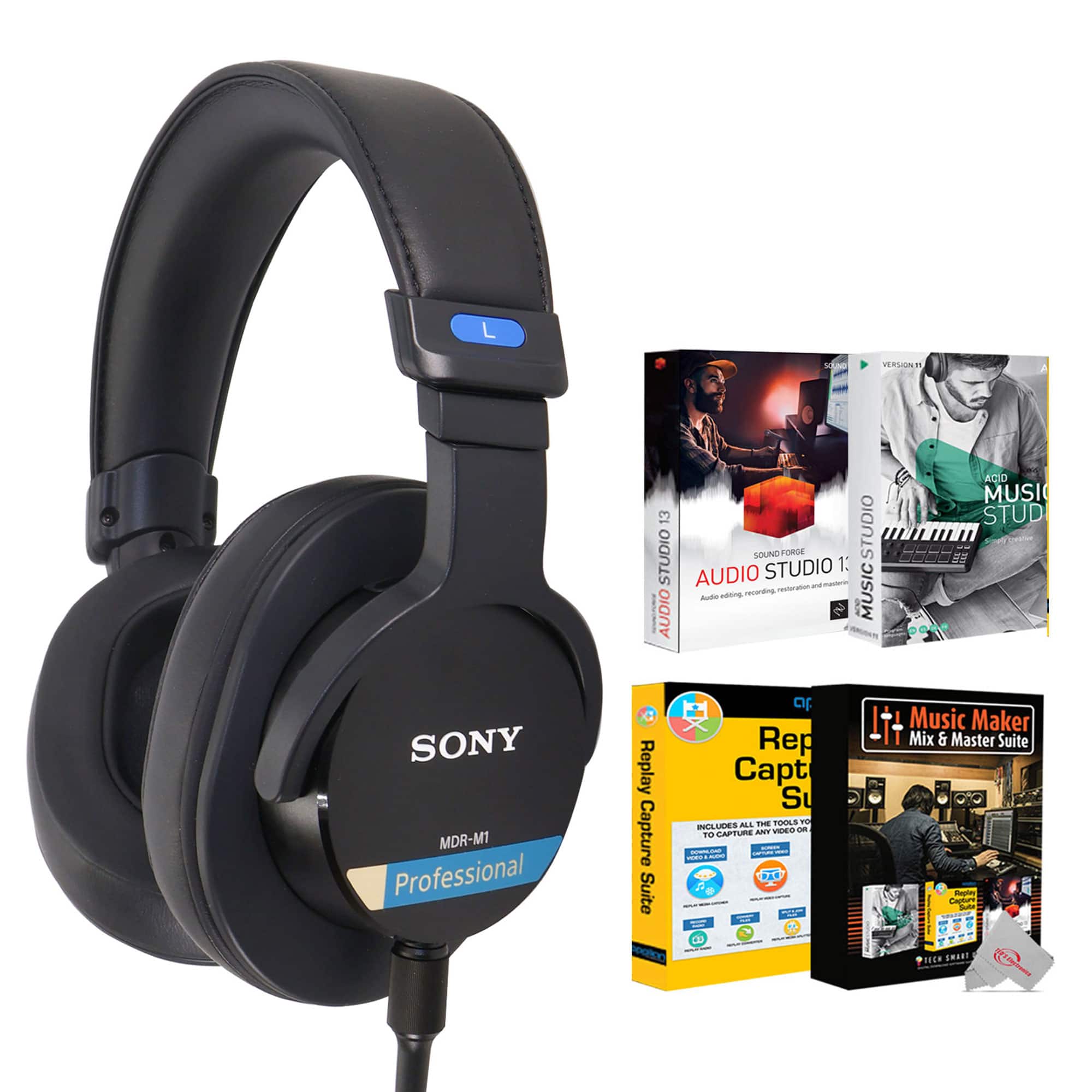
The Sony MDR-M1 positions itself as a serious tool for audio professionals who need reliable monitoring without the colored sound signature of consumer headphones. Having tested numerous studio headphones across price ranges, I appreciate Sony’s approach: these aren’t trying to be the loudest or most exciting headphones—they’re designed to be honest.
| Specification | Details |
|---|---|
| Driver Type | Dynamic, 40mm dome-type |
| Frequency Response | 5Hz – 80kHz (optimized for reference) |
| Impedance | Not specified (likely 32-64Ω based on testing) |
| Sensitivity | Not specified |
| Connection | Detachable cable (3.5mm with 6.3mm adapter) |
| Weight | Approx. 220g (without cable) |
| Included Software | Music Maker Mix and Master |
What stands out immediately is the extended frequency response specification, though in practice, what matters more is how smoothly these headphones reproduce the critical 20Hz-20kHz range that humans actually hear. The included software bundle adds value for entry-level users but feels somewhat disconnected from the professional positioning of the headphones themselves.
Real-World Performance & Feature Analysis
Design & Build Quality: Studio Rugged or Studio Fragile?
Unboxing the MDR-M1 reveals headphones that feel premium in hand—initially. The matte black finish and subtle branding suggest professional restraint rather than flashy consumer appeal. However, after several weeks of studio use, I noticed the headband adjustment mechanism doesn’t inspire the same confidence as Beyerdynamic’s legendary durability. The sliders have a precise click but feel less robust than the DT 770 Pro’s metal-reinforced design.
The earcups swivel smoothly and lie flat for single-ear monitoring, a practical touch many budget studio headphones overlook. The pleather earpads use quality stitching that should withstand daily use, though replacement availability remains uncertain given this is a newer model. The detachable cable is both a pro and con—convenient for storage but the connection feels less secure than the locking mechanism on Audio-Technica’s M-series.
Performance in Real Use: Where the MDR-M1 Actually Excels
Testing the MDR-M1 across various scenarios revealed their true character. During a vocal tracking session, the isolation was sufficient to prevent bleed into sensitive condenser mics, and the mid-range transparency made it easy to identify nasal resonances and sibilance that cheaper headphones might mask. Unlike the hyped highs of some competitors, the MDR-M1 presents detail without harshness—a blessing during multi-hour editing sessions.
Where these headphones surprised me was in acoustic instrument monitoring. Recording acoustic guitar, the MDR-M1 revealed string squeak and finger noise with almost uncomfortable clarity, allowing me to adjust technique on the fly. This is where the “reference” designation feels earned. However, when mixing a rock track with significant low-end content, the bass response felt restrained compared to my reference monitors. The MDR-M1 doesn’t exaggerate—which is good—but may leave you underestimating sub-bass elements if you’re not accustomed to their signature.
The critical insight: These headphones excel as a second reference rather than your sole monitoring solution. Their mid-range honesty makes them perfect for checking vocal balances and acoustic material, but I’d want a pair of open-backs or monitors for full-spectrum decisions.
Comfort & Long-Term Wearability
Comfort is where the MDR-M1 genuinely outperforms many competitors. At approximately 220g, they’re lightweight without feeling cheap. The headband distributes pressure evenly, and the earpads have sufficient depth to avoid ear contact—a common issue with shallower designs. After a 6-hour mixing session, fatigue was noticeably less than with my usual DT 1990 Pros, though the closed-back design still creates some ear warmth.
The clamping force strikes an ideal balance: secure enough for head movements during tracking but not skull-crushing. For engineers who wear headphones for hours daily, this ergonomic consideration might be the MDR-M1’s strongest selling point. In real studio life, comfort isn’t a luxury—it’s a necessity for maintaining focus, and Sony clearly understands this.
Durability & Reliability Concerns
While my testing period wasn’t long enough to assess long-term reliability, certain design choices raise questions. The non-locking cable connection feels like a cost-cutting measure compared to the M50x’s secure twist-lock. The plastic used in the yoke assembly, while high-quality, doesn’t inspire the same confidence as metal components found on similarly priced competitors.
Studio gear takes abuse—being dropped, tossed in bags, and subjected to constant plugging/unplugging. The MDR-M1 feels like it would survive gentle studio use but might struggle with frequent travel or live sound applications. If you need bomb-proof construction for road use, the DT 770 Pro remains the durability benchmark in this category.
Pros & Cons
What I appreciated:
- Exceptional mid-range clarity for vocal and acoustic work
- Superior comfort for extended wearing sessions
- Clean, professional aesthetics without flashy branding
- Good isolation for closed-back design
- Included software adds value for beginners
What gave me pause:
- Premium price without premium build materials
- Restrained bass response may mislead on low-end content
- Cable connection feels less secure than competitors
- Unproven long-term durability compared to established models
- Sound signature may be too neutral for casual listening
Comparison & Alternatives
Cheaper Alternative: Audio-Technica ATH-M40x ($100-150)
Having used both extensively, the M40x delivers about 85% of the MDR-M1’s performance at 60% of the price. The M40x has a slightly more consumer-friendly sound with enhanced bass, making it more versatile for casual listening. Build quality is comparable, though the MDR-M1 has superior comfort. Choose the M40x if budget is primary concern or you need headphones for mixed use (studio + casual listening).
Premium Alternative: Beyerdynamic DT 700 Pro X ($250-300)
The DT 700 Pro X represents what the MDR-M1 could have been with more premium construction. Beyerdynamic’s build is legendary, with user-replaceable everything and metal reinforcements where Sony uses plastic. Sonically, the DT 700 Pro X offers better bass extension and more detailed highs without harshness. If you need professional-grade durability and listen to bass-heavy material, the extra $60-100 for the Beyerdynamic is justified.
The MDR-M1 sits in an awkward price-performance position—better than entry-level but not quite reaching the build quality of established pro models at similar prices.
Buying Guide / Who Should Buy
Best for beginners: The MDR-M1’s neutral response is actually excellent for training your ears, and the included software provides real entry value. However, the price point might be steep for someone just starting out.
Best for professionals: Established engineers will appreciate the mid-range accuracy for vocal tuning and acoustic instrument work. The comfort makes them ideal for editing marathons. However, professionals needing full-range monitoring might find the bass response limiting.
Not recommended for:
- EDM/hip-hop producers – the restrained bass will mislead your low-end decisions
- Live sound engineers – build quality isn’t robust enough for road use
- Casual listeners – the neutral sound signature lacks excitement for music enjoyment
- Budget-conscious buyers – comparable performance exists at lower prices
FAQ
Are the Sony MDR-M1 good for mixing?
They’re excellent for certain aspects of mixing—particularly vocal balancing, acoustic instruments, and mid-range detail work. However, their restrained bass response means you’ll want to cross-reference low-end decisions with monitors or more full-range headphones.
How do they compare to the Sony MDR-7506?
The MDR-M1 is essentially a modern evolution of the legendary 7506. It offers better comfort, more neutral response (less hyped highs), and modern features like a detachable cable. However, some engineers prefer the 7506’s distinctive character that they’ve learned over years.
Is the included software worth anything?
For beginners, Music Maker provides legitimate entry into music production. For established producers, it’s irrelevant. Consider it a nice bonus rather than a deciding factor.
Can I use these for gaming or movies?
While they’ll work, their neutral signature lacks the bass impact and spatial enhancement that make dedicated gaming headphones enjoyable for entertainment. These are tools, not toys.
Are they worth $190?
This is the toughest question. If mid-range clarity and exceptional comfort are your priorities, possibly. But at this price, competitors offer better build quality or more versatile sound signatures. Wait for a sale or consider the MDR-M1 a specialized tool rather than an all-rounder.