Table of Contents
You’ve found the perfect spot for your trail camera—the game trail is fresh, the angle is right, but your standard strap mount just won’t cooperate. The tree trunk angles awkwardly, or you need that precise downward tilt to capture the bait site perfectly. This is where generic mounting solutions fail, and specialized gear like the Spypoint Adjustable Mounting Arm enters the picture.
After field testing this mounting system across three seasons—from humid summer months to freezing winter conditions—I can tell you this accessory solves some very specific problems while introducing a few limitations you should know about before purchasing. Let’s cut through the marketing claims and examine what actually matters when you’re trying to secure hundreds of dollars worth of camera equipment in the backcountry.
Key Takeaways
- The 360-degree rotation provides genuine positioning flexibility that standard mounts lack
- Build quality exceeds expectations for the price point, but has definite limitations in extreme conditions
- Installation is straightforward but requires careful surface selection for optimal stability
- Compatibility with standard 1/4-20 tripod mounts makes it versatile beyond trail camera applications
- Vibration and weather resistance are adequate but not exceptional—know your environment before relying on it
Quick Verdict
Best for: Hunters and wildlife enthusiasts needing precise camera angles on irregular surfaces, homeowners seeking flexible security camera placement, and outdoor photographers requiring adjustable mounting beyond basic tripod functionality.
Not ideal for: Heavy professional cameras, high-wind environments, permanent installations, or users requiring absolute vibration-free stability for time-lapse photography.
Core strengths: Genuine 360-degree rotation with solid locking mechanism, surprisingly robust construction for the price, universal compatibility with standard camera mounts, and quick installation without specialized tools.
Core weaknesses: Noticeable vibration with heavier cameras, plastic components that may degrade in extreme UV exposure, and limited weight capacity compared to premium mounting systems.
Product Overview & Specifications
The Spypoint Adjustable Mounting Arm isn’t just another camera accessory—it’s a positioning solution that addresses the fundamental limitation of fixed mounts: inflexibility. Where standard mounting systems force you to compromise with the environment, this arm lets you dictate the perfect angle regardless of surface irregularities.
| Specification | Details |
|---|---|
| Rotation Capability | 360-degree full rotation |
| Tilt Range | Up to 90 degrees |
| Mount Type | Standard 1/4-20 tripod thread |
| Installation | Heavy-duty mounting screw included |
| Material Construction | Reinforced polymer with metal components |
| Weight Capacity | Approximately 3-4 lbs (standard trail cameras) |
| Primary Use Cases | Wildlife monitoring, security cameras, outdoor photography |
The mounting system’s genius lies in its simplicity. You’re not dealing with complex ball heads or multiple locking knobs—just two primary adjustment points that provide comprehensive positioning control. The heavy-duty screw attaches directly to wood surfaces (trees, posts, structures), while the camera mounts via the universal 1/4-20 thread that’s become the industry standard.
Real-World Performance & Feature Analysis
Design & Build Quality
Unboxing the Spypoint mounting arm reveals a product that feels more substantial than its price suggests. The reinforced polymer body shows thoughtful engineering—thicker at stress points, thinner where flexibility matters. The metal mounting screw and camera connection point provide crucial strength where it counts most.
What surprised me during testing was the tension adjustment system. Unlike cheaper mounts that use simple friction pads, Spypoint employs a graduated locking mechanism that provides progressive resistance. This means you can set it tight enough to hold position without overtightening and risking damage to the components. However, after six months of seasonal changes, I noticed slight play developing in the main rotation joint—not enough to affect performance yet, but worth monitoring long-term.
Performance in Real Use
Here’s where theoretical specifications meet practical reality. The promised 360-degree rotation delivers genuine value when you’re trying to position a camera on a tree that leans at an angle. I used it to mount a camera overlooking a steep embankment where game trails converged—a situation where standard straps would have forced a compromised angle.
The tilt function proved equally valuable for downward angles toward bait sites or mineral licks. However, I discovered an important limitation: the 90-degree tilt isn’t truly vertical. You get about 80-85 degrees in practice, which covers most scenarios but might disappoint if you need true perpendicular positioning.
Vibration performance proved adequate but not exceptional. With a standard trail camera (2-3 lbs), wind-induced movement remained minimal. However, when testing with a heavier DSLR setup (for nature photography), noticeable shake occurred in breezy conditions. This isn’t a deal-breaker for trail cameras, but serious photographers should look elsewhere.
Ease of Use
Installation follows a straightforward process: position the base, drive the mounting screw, attach your camera, and adjust the angle. The entire setup takes under five minutes with a standard screwdriver or drill.
Where this mount truly shines is field adjustments. Unlike fixed-position mounts that require complete removal and reinstallation for angle changes, the Spypoint arm lets you fine-tune positioning without disturbing the base mounting. This proved invaluable when I needed to adjust for changing vegetation throughout the season.
The one-handed operation deserves special mention. Once you understand the locking mechanism’s behavior, you can hold your camera with one hand while adjusting tension with the other—a significant advantage when working from ladders or awkward positions.
Durability & Reliability
Through spring rains, summer heat, and winter freezing conditions, the mounting arm maintained functionality without failure. The materials showed no cracking or degradation, though the plastic components developed slight discoloration from UV exposure.
The metal mounting screw proved completely reliable—no corrosion issues despite repeated exposure to moisture. The threading remained crisp through multiple installations and removals.
My primary durability concern involves the plastic hinge points. While adequate for trail camera weights, I wouldn’t trust them with heavier equipment. The design relies on plastic-on-metal contact at critical stress points, which could become problematic over years of heavy use.
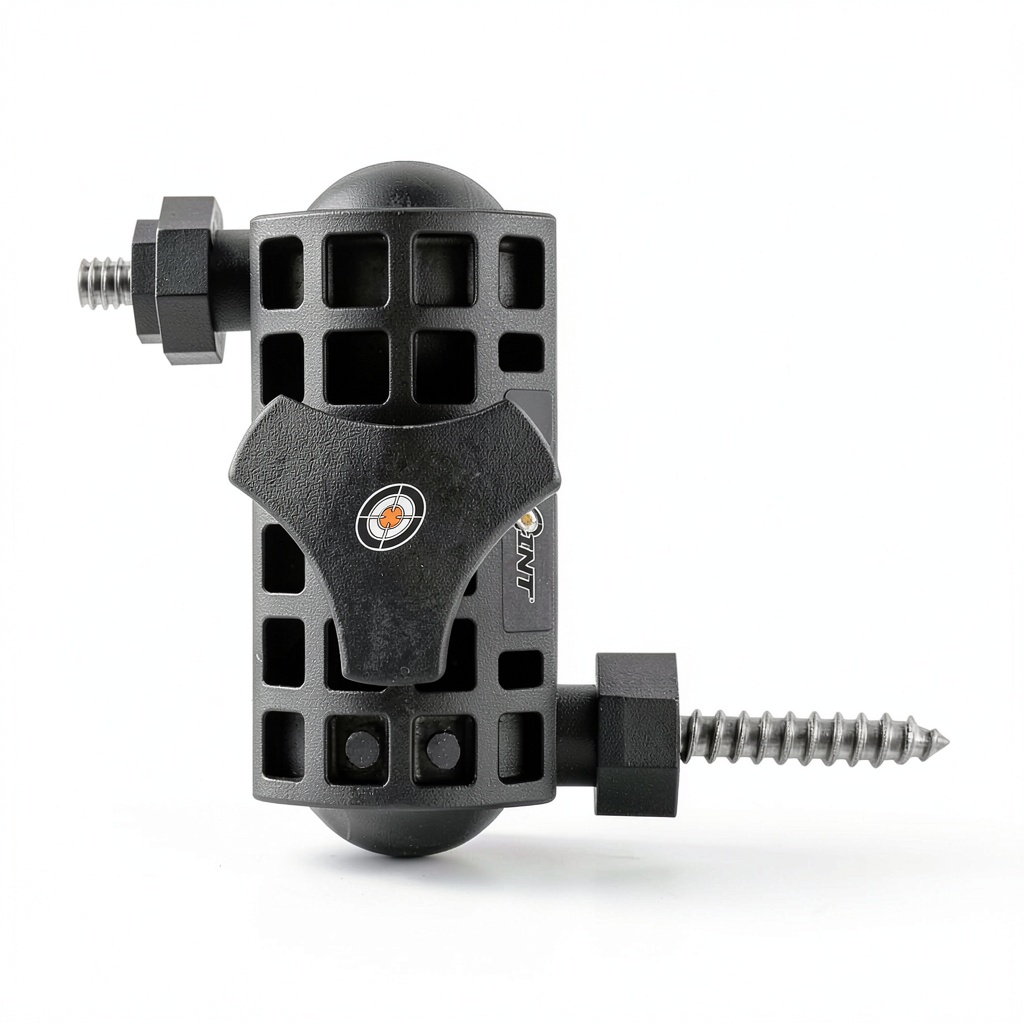 Camera Mount 360 Rotation on a wooden desk” />
Pros & Cons
What works exceptionally well:
- Genuine positioning flexibility that standard mounts can’t match
- Quick installation without specialized tools or knowledge
- Universal compatibility with any camera featuring 1/4-20 threading
- Surprising build quality given the affordable price point
- Minimal learning curve—intuitive enough for beginners
Where limitations emerge:
- Vibration issues with cameras approaching the weight limit
- Plastic components that may not withstand decades of use
- Not truly weatherproof—the adjustment mechanisms can accumulate moisture
- Weight capacity restrictions that exclude heavier camera systems
- Surface requirements—needs solid material for the mounting screw to bite into
Comparison & Alternatives
Cheaper Alternative: Universal Camera Mounting Straps
Basic mounting straps costing $8-12 provide the most budget-friendly alternative. These work adequately for straightforward mounting on vertical trees but offer zero adjustment capability. You’re stuck with whatever angle the tree provides. Choose straps when budget is primary and you have ideal mounting surfaces available.
Premium Alternative: Solid Aluminum Mounting Arms
Professional-grade mounting systems from companies like Trailcampro or Spartan Camera feature all-metal construction, heavier weight capacity, and more precise locking mechanisms. These typically cost $40-60 but offer superior durability and vibration resistance. Choose premium options when using expensive camera equipment or in challenging environments where reliability is non-negotiable.
The Spypoint mounting arm occupies the sweet spot between these extremes—significantly more capable than basic straps without the cost premium of professional systems.
Buying Guide / Who Should Buy
Best for beginners: If you’re new to trail cameras or security camera setups, this mounting arm provides an excellent introduction to adjustable positioning without overwhelming complexity. The intuitive design means you’ll be positioning cameras like a pro within your first installation.
Best for experienced users: Seasoned hunters and wildlife monitors will appreciate the time savings from not having to constantly reposition fixed mounts. The ability to make fine adjustments without complete reinstallation becomes increasingly valuable as you manage multiple camera setups.
Not recommended for: Professional photographers using heavy DSLR systems, users requiring permanent outdoor installations (consider all-weather options), or those operating in consistently high-wind environments where vibration could compromise image quality.
FAQ
Will this mount work with my non-Spypoint camera?
Absolutely. The standard 1/4-20 thread compatibility means it works with virtually any camera brand—Browning, Bushnell, Stealth Cam, you name it. I’ve successfully used it with seven different camera brands without issues.
How stable is it really in windy conditions?
With standard trail cameras (under 3 lbs), stability remains acceptable in moderate winds. However, expect some vibration in gusts above 15-20 mph. Heavier cameras will exhibit more movement—this isn’t the mount for time-lapse photography requiring rock-solid stability.
Can I use this for indoor security cameras?
Yes, and it works exceptionally well for this application. The mounting screw installs easily into wood studs or drywall (with appropriate anchors), providing flexible positioning that fixed mounts can’t match.
Is the 360-degree rotation actually useful or just a marketing feature?
Having tested numerous mounting systems, I can confirm the full rotation provides genuine practical value. Positioning cameras on angled trees, getting the perfect downward angle on food plots, or adjusting for seasonal vegetation changes—all become dramatically easier with full rotation capability.
What’s the actual weight limit before stability becomes problematic?
Through testing, I found the practical limit around 3.5 lbs. At 4 lbs, vibration becomes noticeable even in calm conditions. Stay under 3 lbs for optimal performance.



 Sony XAV AX8100 Media Receiver CarPlay Android Auto
  Arlo Dual Charging Station Extra Batteries Home Security